🏡 What’s the Difference Between Family and Kin?
Ever wondered about the difference between “family” and “kin”? While often used interchangeably, these words have unique meanings that shape our understanding of relationships. Let’s break it down.
💬 In a Nutshell
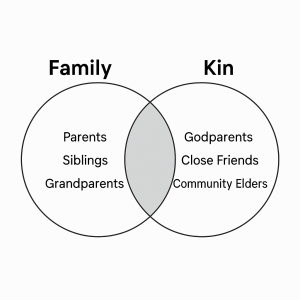
- Family typically refers to your closest relational circle—those connected by blood, marriage, or adoption. This includes the people you often live with: parents, siblings, children, grandparents, aunts, uncles, and first cousins.
- Kin is a broader, more flexible concept. It includes your biological and legal family and extends to anyone you consider family. This can encompass godparents, cherished family friends, mentors, or members of your community who feel like home.
So, the simple rule is: All family are kin, but not all kin are family.
📊 Visualizing the Difference
🧠 Why Understanding This Matters
Both family and kin are foundational to our identity. They provide us with love, support, and a crucial sense of belonging. From them, we learn our values, traditions, and how to navigate the world with empathy. Recognizing the role of both groups helps us appreciate the full spectrum of support in our lives.
👥 Traditional Roles
- In a Family Unit: Roles are often clearly defined—parents or guardians provide care and stability, while siblings offer companionship and mutual support as they grow.
- In a Kin Group: Roles can be more cultural and communal. Elders may serve as advisors and keepers of tradition, while younger members are often expected to show respect and help maintain family bonds.
It’s important to remember these roles can vary significantly across different cultures and family situations.
🧬 The Different Types of Kin
We can categorize kin into a few main types:
- Blood Kin: Relatives connected by birth (biological parents, siblings, children).
- Affinal Kin (Kin by Marriage): Relatives connected through legal unions (spouses, in-laws, step-family).
- Fictive Kin (Chosen Kin): Individuals who are not related by blood or marriage but who are granted the status and love of family (e.g., godparents, “aunts” and “uncles” from friendship, close mentors).
🌍 The Cultural Lens
The importance of family vs. kin is deeply cultural. In many societies around the world, the extended kin network is the primary source of identity and support. In others, the focus is more on the immediate, nuclear family, emphasizing independence. There’s no right or wrong—just different beautiful ways of building connection.
🔄 The Evolution of Family and Kin
These concepts are not frozen in time. Modern life—with increased mobility, evolving gender roles, and digital technology—is constantly reshaping our circles. Families today are beautifully diverse. Many people now build robust support systems from chosen kin, including friends and online communities, proving that the need for belonging is universal, even as the definitions expand.